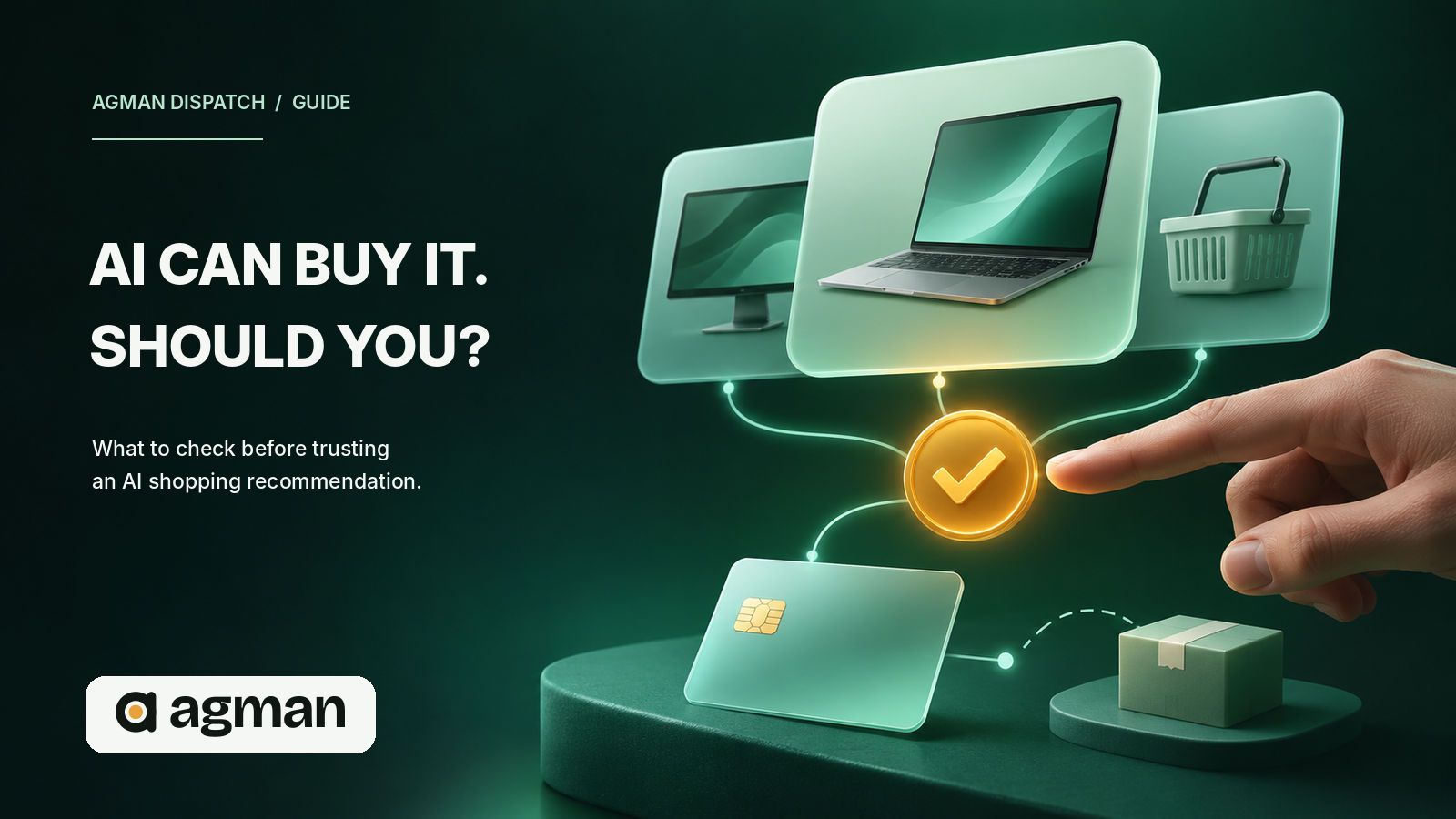
Imagine asking an AI assistant to find a laptop for remote work. You give it your budget, preferred screen size and the software you use. It compares options, visits a retailer, adds a laptop to your cart and prepares the checkout. You review the order and approve the payment.
That last step is becoming real. But it raises an important question: how do you know the AI chose the right laptop, from the right seller, at the right price? Secure payment answers only part of it. The rest depends on checks you can make yourself, and this guide sets out five of them.
On November 10 and 13, 2026, OpenAI announced two developments that bring this question closer to everyday shopping: Businesses in ChatGPT and ChatGPT Wallet. Neither means AI can reliably handle every purchase or that human judgment is no longer needed.
What exactly did OpenAI launch?
Businesses in ChatGPT: making companies easier to find and understand
On November 10, OpenAI introduced Businesses in ChatGPT in beta. Through Business Hub, eligible companies can claim their business profiles, verify their authority to manage them, update information and provide product feeds containing prices and availability. The platform also provides aggregated insights into mentions, website clicks and discovery topics, subject to privacy thresholds.
For users, current information supplied by the business may help them evaluate the options when they ask about a product or service.
OpenAI also introduced Business Agents, which let customers have a separate conversation with a participating company about its products and services. Someone comparing two software plans, for example, could ask the company's agent which features each plan includes.
Business profiles can be claimed by eligible companies in supported ChatGPT markets. Business Agents, however, initially serve eligible ecommerce and online service businesses in the United States. Neither eligibility condition is a promise of visibility or sales.
Source: OpenAI — Introducing Businesses in ChatGPT, November 10, 2026
ChatGPT Wallet: moving from choosing to purchasing
Three days later, on November 13, OpenAI introduced ChatGPT Wallet. The initial rollout allows eligible ChatGPT Pro subscribers in the United States to use their dots, OpenAI's personal agents, to help complete purchases. Users add an eligible US-issued credit card (debit cards are not supported at launch) and review each purchase before approving it with biometric verification.
Instead of sharing the actual card number with the shopping agent or merchant, the payment system supplies a substitute payment credential. This keeps the real card details out of the agent's purchase flow, while existing card protections may still apply to qualifying disputes.
The rollout is limited, though. Users must be adults in the US with an eligible US-issued credit card and a US billing address. It is rolling out gradually, and not every merchant can support agent checkout.
Source: OpenAI — Introducing ChatGPT Wallet, November 13, 2026
How does buying something with an AI agent actually work?
Consider a hypothetical example. You need a monitor for working from home: a 27-inch display, USB-C connectivity, a specific budget and delivery within a few days. You ask an assistant to find suitable options. It researches products, compares specifications and prepares a purchase at a participating store. With ChatGPT Wallet, an eligible user could then review the merchant, items, total price and selected payment card before authorizing payment.
But there are two different kinds of correctness here.
Transaction correctness: did the user authorize the intended purchase amount and payment method?
Decision correctness: is this actually the right monitor, from a reliable seller, with suitable specifications and acceptable return conditions?
Payment authentication helps with the first. It does not solve the second: an assistant could correctly execute a purchase for a monitor that turns out to be incompatible with your computer. The card details stay protected, and the order is still a poor decision.
Five things to check before allowing AI to make a purchase
A useful AI shopping assistant should reduce research without hiding important decisions. These checks help you evaluate its recommendation.
1. Does the product actually fit your requirements?
An AI recommendation should be traceable to specific requirements, not just a broad category or a positive product description. For a monitor, that might include resolution, ports, operating-system compatibility, warranty and delivery location. For software, check integrations, usage limits and data export.
Ask it to separate confirmed specifications from assumptions. A claim such as "supports USB-C" is not enough if you need USB-C video output and laptop charging.
2. Who is actually selling the product?
The brand, the seller and the marketplace can be different organizations. A familiar product sold by an independent retailer can come with different warranty handling, returns, delivery and support.
Before buying, verify the seller's identity on its official website and check whether it is an authorized seller where that matters. A credible AI recommendation does not remove the need to assess the merchant.
3. What is the complete cost?
Price comparisons mislead when they leave out delivery, taxes, renewals or usage charges. Suppose an AI recommends a design application advertised at $12 per month. That price tells you little until you know whether billing is monthly or annual, how many credits are included and what happens when you exceed the plan's limits.
Ask for the total payable amount and any ongoing commitment. For subscriptions, pay particular attention to renewal dates, cancellation conditions and trial conversion.
4. Is the payment authorization the same as a confirmed order?
No. OpenAI's Wallet guidance explicitly distinguishes approval from merchant acceptance: a user may authorize payment, yet checkout can still fail or remain unresolved.
Check the merchant's confirmation and order status before retrying; repeated attempts after an agent error can leave confusing pending transactions. Keep the merchant's receipt or order reference, not just the AI conversation.
5. What happens if the product is wrong?
An AI agent may help place an order, but it does not necessarily become responsible for fulfilling it. OpenAI's Wallet terms state that the merchant remains the seller. Returns, delivery issues and refunds generally follow the merchant's policies, and card issuers handle relevant payment disputes, subject to their agreements and applicable rights.
Before an unfamiliar purchase, find the return policy and how to reach the seller directly. A good shopping assistant leaves you able to explain what you bought, why you chose it and what happens if something goes wrong.
Can a Business Agent give independent advice?
A Business Agent has a different role from a general assistant. It represents a participating business and helps explain that business's offerings. OpenAI says these conversations are labeled and kept separate from the original ChatGPT response, and businesses can also sponsor their Business Agents through clearly labeled advertising placements.
That does not make its information inaccurate; a company often knows its products better than an outside reviewer. But it is not an independent comparison of the market. Use independent research to find options, ask each business for factual details, then compare the answers against your requirements.
What should founders and small businesses learn from this?
Many small businesses invest in attractive websites while leaving basic purchase information hard to find: delivery coverage, pricing conditions, compatibility, refund rules. An AI-assisted buyer hits the same gaps. If product information is incomplete or contradictory, an agent may struggle to compare reliably or to complete checkout. Several improvements are worth making now, whether or not you use the new features.
Keep product information current. Names, descriptions, availability, prices and variants should agree across the website, product feeds and checkout.
Make important terms easy to find. Explain what a product includes, who it is for and what limitations apply. Show support, cancellation, delivery and return conditions clearly.
Check the path from discovery to purchase. Does the product page lead to a working checkout? Are variants selectable? Are shipping and tax calculations clear?
Review how your site treats legitimate automated visitors. Bot protection that blocks every non-human request may also stop an agent acting for a real customer. Review this carefully rather than removing normal security protections. We looked at why many retailers block shopping agents in Agentic Commerce Is Growing. So Why Are Websites Blocking AI Shopping Agents?
Measure actual outcomes. Mentions, visits, completed orders, returns and satisfaction are different measures; a rise in one doesn't prove a rise in the others.
Business Hub may give verified companies another place to maintain information and see aggregated discovery activity, but there is no basis for assuming a claimed profile guarantees ranking, referrals or customers. Better underlying product information is the sensible first step either way. For the discovery side, see how to get your software recommended by ChatGPT.
What these announcements do not prove
A new capability is not evidence that most customers want agents to shop for them. The rollout is limited, and OpenAI itself acknowledges that merchant systems and payment risk controls still need to adapt. Nothing in these announcements shows that agent-led purchases produce better decisions, lower prices, fewer returns or higher customer satisfaction. Those outcomes need independent measurement.
There are plausible reasons for caution: models can misunderstand requirements, product information goes out of date, and retailers may show different terms by location, inventory or account. A straightforward repeat purchase from a trusted seller might work well with an agent. A complex service, medical equipment or a long-term contract may need closer human or professional review.
The useful question is not whether an agent can complete the transaction, but whether delegating part of it improves the outcome without unacceptable risk.
A practical test you can use today
You do not need ChatGPT Wallet for this. Pick a product or service you are already considering and write down your requirements before asking an assistant for recommendations: your budget, must-have features, location and any restrictions. Then ask it to compare two or three options using the same criteria.
For each recommendation, request:
- The exact product and seller.
- Evidence for each must-have requirement.
- Total cost and recurring charges, where applicable.
- Important limitations or missing information.
- The official source used to verify those details.
Open the source links and check the key claims yourself. If the assistant cannot show that a product meets an essential requirement, treat it as an open question, not a confident yes.
The exercise measures something more useful than how impressive the answer sounds: whether it helps you make a decision you can defend.
Frequently asked questions
Is ChatGPT Wallet available everywhere?
No. As of November 16, 2026, the initial rollout is limited to eligible adult ChatGPT Pro subscribers in the United States using eligible US-issued credit cards through dots. Availability is gradual.
Does ChatGPT Wallet make purchases without permission?
The initial workflow requires the user to review and approve individual purchases with a security check. OpenAI has discussed broader future delegation with defined limits, but that should not be confused with the current rollout.
Can a business guarantee visibility by claiming a ChatGPT profile?
No. A verified profile gives an eligible business a way to manage information and access supported features. It does not establish a guaranteed place in recommendations.
The real opportunity is better decisions
AI-assisted commerce could remove real friction: searching across websites, comparing features and preparing purchases are repetitive tasks agents may make easier. But convenience and trust are separate achievements. A good agent should do more than reach the payment screen. It should help people understand the options, see the uncertainty and keep control of the final commitment.
The next meaningful measure of progress will not be how many purchases an AI agent can complete. It will be how often those purchases were the right ones.
Sources
- OpenAI — Introducing Businesses in ChatGPT, November 10, 2026
- OpenAI — Introducing ChatGPT Wallet, November 13, 2026
- OpenAI — Making Purchases With ChatGPT Wallet
- OpenAI — ChatGPT Wallet Terms, effective November 12, 2026
Feature availability and policies reflect information checked on November 16, 2026. Examples in this article are illustrative, not reports of actual purchases.