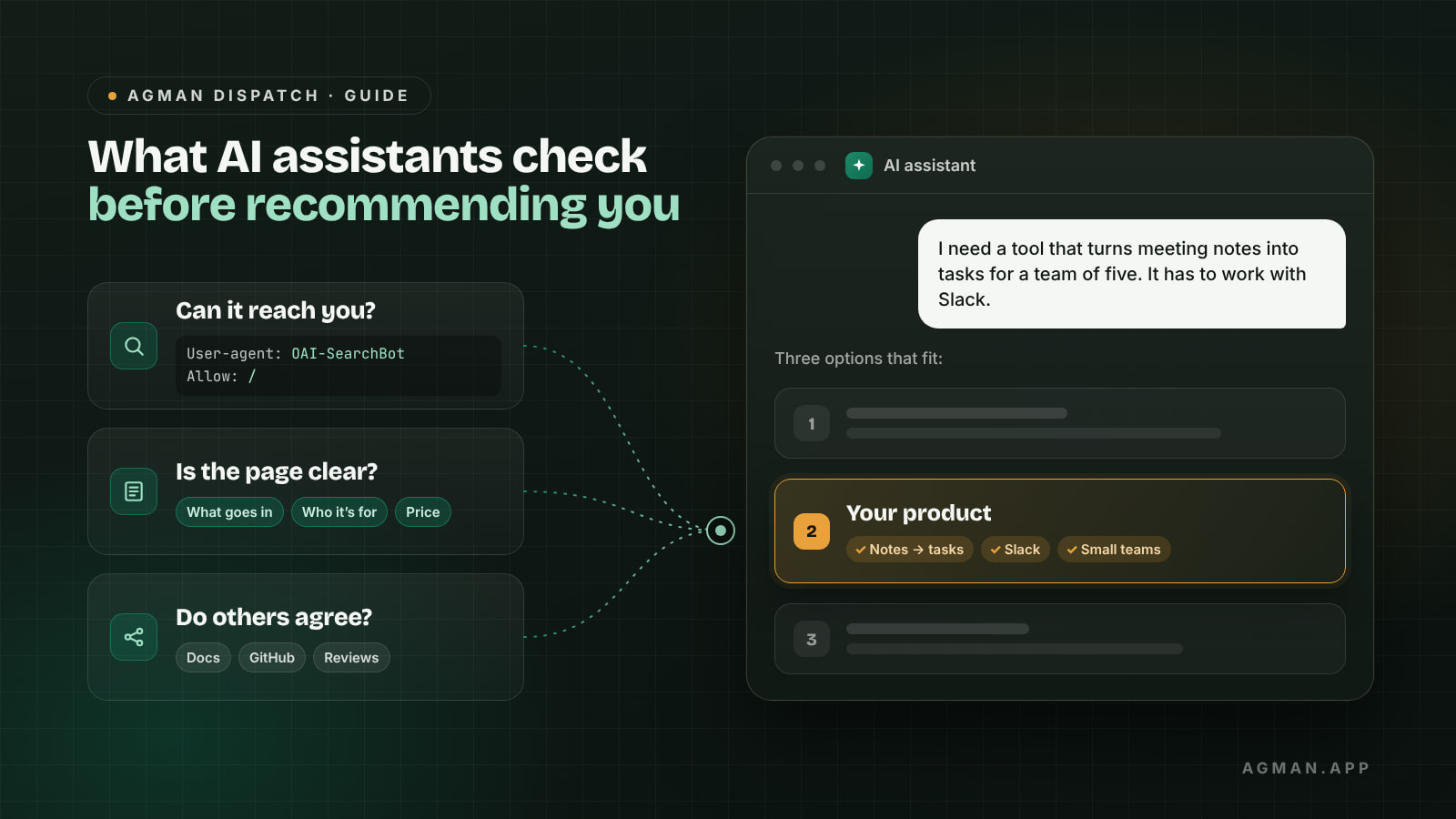
Picture someone typing this into ChatGPT: "I need a tool that turns meeting notes into tasks for a team of five, and it has to work with Slack." A few seconds later they have three suggestions, each with a short reason. They click one, and that may be the whole search.
If you built exactly that tool, the uncomfortable question is why it wasn't one of the three. (The scenario is hypothetical, but the pattern is familiar to anyone who has watched people search this way.)
Most advice about getting recommended by ChatGPT is written for online shops. It talks about product feeds, Merchant Center, prices and star ratings. That helps if you sell trainers. It does very little if you make a SaaS tool, a mobile app, a developer library or a freelance service, because there is no feed to optimise.
For software and services the work is different, and in some ways simpler. An AI assistant can only recommend something it can reach, read and confidently match to the need someone described. Most of the effort goes into making your product easy to describe in the same plain words everywhere it appears.
Can ChatGPT find your website at all?
Start here, because everything else depends on it. ChatGPT search uses a crawler called OAI-SearchBot, and OpenAI says sites that block it will not be shown in ChatGPT search answers, apart from plain navigational links.
OpenAI treats that crawler separately from GPTBot, the one used to collect training data. According to OpenAI's crawler documentation, you can allow OAI-SearchBot while blocking GPTBot, and changes to robots.txt take roughly 24 hours to take effect.
Open yourdomain.com/robots.txt and look for any rule that blocks OAI-SearchBot, or that blocks everything with User-agent: * and Disallow: /. Some security plugins and hosting presets add these without asking. If your product pages need JavaScript to show any text at all, check what a plain page fetch returns too, since a page that renders nothing without scripts gives a crawler nothing to read.
Do Google's AI Overviews and AI Mode work differently?
Less than you might expect. Google's guidance for site owners says a page has to be indexed and eligible to show in Search with a snippet to appear as a supporting link, and that there are no extra technical requirements for AI features.
One detail is worth understanding. Google describes a "query fan-out", where AI Mode and AI Overviews run several related searches to build one answer. A broad question like "best note-taking app for small teams" may quietly become narrower searches about integrations, pricing or team size. Pages that answer those narrower questions clearly have more chances to be picked up than a homepage that says your product "boosts productivity".
What should your product page actually say?
Write the page for the question a person would ask, not for the category you'd like to own. A useful test is whether someone could repeat back, after ten seconds, what the product does, who it is for and what they would get out of it.
Compare two descriptions of the same hypothetical tool:
- Vague: "An AI-powered productivity platform that helps teams work smarter."
- Specific: "Paste or upload meeting notes and get a task list with owners and due dates. Built for teams of 3 to 20. Sends tasks to Slack or Linear. Free for one workspace, paid plans from $8 per user."
The second version answers the questions an assistant is likely to check: what goes in, what comes out, who it suits, what it connects to and roughly what it costs. Saying clearly who it's built for also helps a model avoid recommending you for the wrong job.
A few page elements carry a lot of weight:
- A plain-language summary near the top, using the words customers use for the problem.
- Use-case sections written as questions ("Can I use it for client meetings?") with a direct answer underneath.
- Honest comparisons with the alternatives people actually consider, including when the alternative is the better choice.
- Structured data that matches what the page visibly says, such as
SoftwareApplicationfor an app. Markup that claims things the page doesn't show creates more confusion, not less.
Why do other websites matter so much?
Because an assistant is weighing whether to trust you, and your own homepage is the least independent source there is. Marketing guides that study these recommendations, such as HubSpot's, keep returning to the same point: consistent descriptions of a product on other reputable sites make it easier to recommend with confidence. OpenAI hasn't published a formula, so treat this as observed practice rather than a rule.
For software, those other places are fairly predictable. Your GitHub README, documentation, integration marketplaces, launch platforms, discovery networks, review sites, communities where you answered questions honestly, and articles that explain the problem you solve. You don't need to be everywhere. You need the places that do mention you to describe the product in the same way.
Inconsistency is a common and fixable problem. If your App Store listing calls the product a "planner", your website calls it an "AI workspace" and your Product Hunt page calls it a "meeting assistant", a model has three different products to reconcile. Pick one clear description and update the old ones.
What doesn't work is manufacturing that corroboration. Fake reviews, paid "best of" lists with no disclosure, and posts in communities you don't belong to tend to get removed, and they put the trust you are trying to build at risk.
How do you know whether it is working?
Ask the assistants yourself, once a month, with the questions your customers would ask. Write down which products appear and how they are described. Answers vary between runs and between tools, so look for a trend over several months rather than reacting to a single answer.
Then check your analytics for visits that arrive from chatgpt.com, perplexity.ai or gemini.google.com. The numbers are usually small at first. AGMAN's own analytics, for example, recorded 18 visitors arriving from chatgpt.com in the 30 days to 20 October 2026. Small is fine. What matters is whether those visitors do something useful once they arrive.
Is this just SEO with a new name?
Mostly, yes, and that is reassuring. Clear pages, accurate structured data and a good reputation elsewhere have always helped people find you through search. The shift is in emphasis. Assistants answer described needs rather than short keywords, and they lean heavily on whether several independent sources agree about what you do.
It is also worth being honest about the limits. No one outside OpenAI or Google can guarantee a recommendation, and anyone who promises one is guessing. Some categories are dominated by large, well-known products, and a newer tool may appear only for narrower, more specific requests. That's often a better place to start anyway.
A short checklist for this week
- Check robots.txt for rules that block
OAI-SearchBot, and confirm your key pages show text without JavaScript. - Rewrite the first paragraph of your product page so a stranger knows what goes in, what comes out and who it is for.
- Add three to five question-style sections answering the specific things customers ask before they choose.
- Make your description consistent on the three or four other sites that already mention you.
- Ask two AI assistants the questions your customers ask, and save the answers so you can compare next month.
Where AGMAN fits
AGMAN is built around the same idea of being found by need. Visitors can describe what they need in their own words with Find by Need and see the pages that fit, with the reason each one matches.
Publisher pages on AGMAN are open to search and AI crawlers, include structured data that describes the product, and are listed in AGMAN's public llms.txt file. A clear AGMAN page can be one more consistent, independent description of what you've built. It doesn't guarantee a mention in ChatGPT, a Google ranking or traffic, and no single page can.
If that sounds useful, you can publish a page from your website link and review every detail before it goes live.