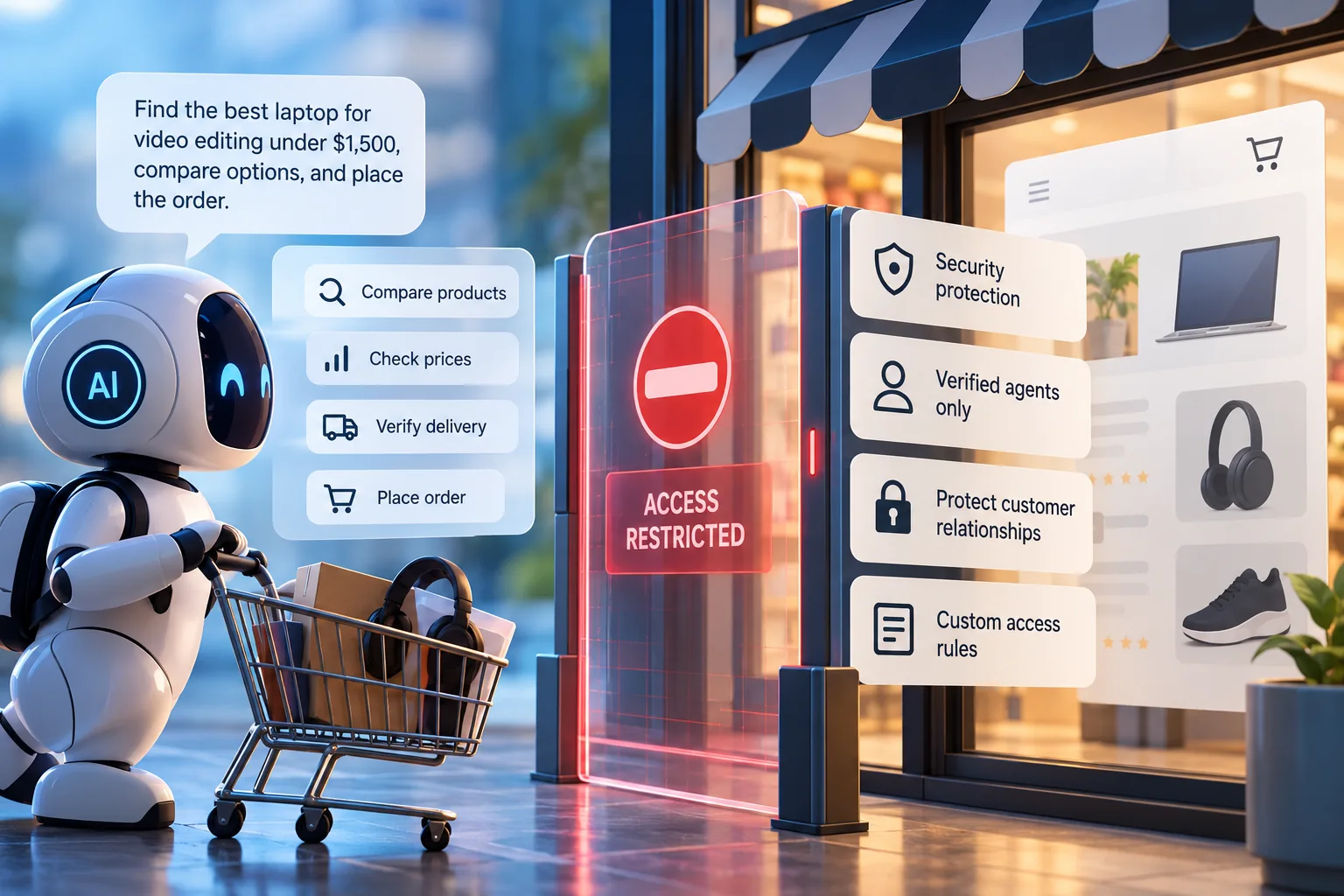
Imagine asking an AI assistant to replace your broken coffee machine.
You give it a budget, mention the features you need, and ask it to compare a few reliable options. It checks prices, looks at delivery dates, reads return policies, and finds a suitable replacement.
Then you tell it to place the order.
Instead of a confirmation, the assistant encounters a security challenge. The retailer's website won't let it continue.
Nothing was wrong with your request. You wanted to make a purchase. The retailer wanted to sell a product. The AI was supposed to make the process easier.
Yet the transaction stopped because the website couldn't, or wouldn't, allow the automated visitor to proceed.
That hypothetical situation captures a real conflict emerging across the internet.
Disclosure: This article was researched and drafted with AI assistance. Sources are linked throughout.
The next customer might arrive through an AI agent
For years, online shopping has followed a familiar pattern. A person searches for a product, opens several websites, compares prices, reads reviews, and eventually completes a checkout.
AI is beginning to change that process.
Instead of searching for a specific product, someone can describe the outcome they want.
A customer might ask for a lightweight laptop suitable for video editing, with good battery life, available for delivery before Friday, within a particular budget.
An AI shopping agent can potentially research the options, compare specifications, check availability, and help move the customer toward a purchase.
This is what the industry calls agentic commerce: using AI systems to carry out parts of the shopping process on someone's behalf.
The interest is measurable, although still developing.
According to Ahrefs' September 2026 research, the keyword "agentic commerce" attracted an estimated 6,400 monthly searches in the United States.
That doesn't mean millions of people are already letting AI shop autonomously. It does show that businesses, developers, and consumers are paying attention to the idea.
And the companies building the infrastructure are moving quickly.
Google and Shopify have collaborated on the Universal Commerce Protocol, an open standard intended to help AI agents and commerce systems communicate across product discovery, checkout, and post-purchase services.
Shopify has also introduced tools that make eligible merchants' products available through AI shopping channels.
The direction is becoming clearer: shopping may increasingly begin in an AI conversation rather than on a retailer's homepage.
But there's a complication.
Being able to find a product doesn't automatically give an AI agent permission to purchase it.
Why would a retailer block someone who wants to buy?
At first, blocking a shopping agent sounds counterproductive.
A retailer spends money attracting potential customers. An AI agent arrives with a specific shopping request. Why stop it?
Because a website cannot assume that every automated visitor is trustworthy.
Traditional bots already create serious problems for businesses. Some scrape pricing and product information at scale. Others attempt fraudulent transactions, abuse promotions, overwhelm systems, or try to access accounts without authorization.
AI agents complicate the distinction.
A legitimate assistant might need to navigate a product page, check stock, add an item to a basket, and proceed to checkout. To a security system, parts of that behavior may resemble the automation it was designed to stop.
Recent reporting illustrates the problem.
In October 2026, The Verge reported that several major websites were restricting AI-agent access for reasons including security, licensing, and platform policies. Amazon's disputes with Perplexity over agent-driven shopping show how contentious that access can become.
Not every restriction is a deliberate rejection of AI commerce. Existing anti-bot protections can also interfere with authorized automation.
This distinction matters.
A website blocking suspicious activity is behaving differently from a company deciding that only approved AI partners may access its shopping infrastructure.
Both can prevent a customer from completing an AI-assisted purchase, but they require different solutions.
There's another concern: who owns the customer relationship?
Security explains only part of the resistance.
Consider how online retailers currently operate.
When a customer visits a store directly, the business controls much of the experience. It can present product information, recommend related items, explain shipping options, provide customer support, and encourage the person to return.
The retailer also gets information about how people find and interact with its products, subject to privacy and consent requirements.
Now imagine a customer who conducts nearly the entire shopping journey through an AI assistant.
The assistant compares competing stores, chooses a product, and potentially completes the transaction without the customer ever opening the retailer's usual interface.
That might be convenient for the buyer.
For the retailer, it introduces important questions.
Will the brand still be recognizable? Can the store communicate relevant details about the product? Who handles a problem after the purchase? Can the business understand which recommendations generated a sale?
And perhaps most importantly, how much control should an intermediary have over the customer's choices?
These concerns aren't entirely new. Search engines, marketplaces, and comparison websites have influenced shopping decisions for years.
AI agents could extend that influence because they may participate in the decision and transaction, rather than simply directing someone to a website.
That creates a commercial tension.
A customer may want an assistant that compares every available option impartially. A retailer may prefer an approved integration that preserves its checkout rules, data controls, and customer relationship.
Neither interest can simply be ignored.
The internet is starting to distinguish between different kinds of AI traffic
One encouraging development is that websites are getting more control over what automated systems do.
In September 2026, Cloudflare introduced updated controls designed to distinguish three categories of AI activity.
Search crawlers gather information so content can be discovered later.
Training crawlers collect information for developing AI models.
Agents interact with websites in real time, potentially acting on behalf of a user.
Those activities have different purposes and different implications for a website owner.
A publisher might welcome appearing in AI search results while refusing to supply its articles for model training. A merchant might permit product discovery while requiring a separate, authenticated method for checkout.
Cloudflare's published controls allow website owners to establish different policies for these activities. Its September defaults also introduced restrictions on certain AI traffic to advertising-supported pages.
This is more nuanced than simply blocking every bot.
The challenge is identifying whether an agent is legitimate, what it has permission to do, and whether the website can trust the request.
An automated shopping assistant should not have unlimited access merely because a customer asked it to buy something.
But rejecting every automated visitor could eventually prevent a business from serving customers who prefer AI-assisted shopping.
A possible solution is taking shape
Rather than letting agents imitate human browsing through whatever interface they encounter, commerce providers are developing more structured ways for AI systems to interact with merchants.
The Universal Commerce Protocol, introduced by Google with Shopify and other industry collaborators in January 2026, is one example.
Its purpose is to establish common ways for participating systems to exchange commerce information and support transactions.
An agent could obtain product information through an approved interface, understand a merchant's checkout requirements, and help the customer complete a purchase through a supported process.
That approach has advantages over blindly clicking through websites.
The merchant can retain control over pricing, availability, order processing, and fulfillment rules. The customer can receive clearer information about what they're purchasing. The agent has a defined way to interact with the system.
However, an open standard doesn't mean every retailer supports it, every AI assistant can use it, or every transaction can happen automatically.
Shopify's current documentation makes an important distinction: some AI channels help shoppers discover products and then direct them to a store's checkout, while supported direct-checkout experiences allow purchases within an AI channel.
Availability also depends on the merchant, region, payment setup, and platform.
The infrastructure is developing, but participation and compatibility remain uneven.
Consumers aren't ready to surrender control either
Much of the conversation about agentic commerce assumes people want an assistant to handle everything.
That assumption deserves scrutiny.
In August 2026, payments company NMI published a survey of 1,000 U.S. adults about AI-assisted shopping and transactions.
Only 11% reported having used AI to complete a transaction.
More importantly, 70% said being able to review or override an AI decision before purchasing was important.
The same research found widespread concerns about payment security and the possibility of AI purchasing an incorrect product.
These are self-reported survey results, not a measurement of every online shopper. Still, they highlight an important distinction between wanting AI assistance and trusting AI with financial authority.
A person might happily ask an assistant to compare five washing machines.
That doesn't mean they want it to spend $800 without asking.
The consequences of an incorrect recommendation are different from those of an unauthorized purchase.
Size, color, quantity, delivery address, return conditions, and payment method all matter at checkout.
An assistant that makes research faster but introduces uncertainty around money may not feel like an improvement.
The more useful model, at least while trust is developing, may be shared control.
Let the agent research the options, handle repetitive work, and prepare a transaction. Let the customer review the important details and authorize the payment.
Automation becomes more valuable when people understand its boundaries.
What should smaller online businesses do now?
Large retailers can negotiate partnerships and invest in specialized integrations. Smaller businesses don't always have that option.
Fortunately, preparing for AI-assisted shopping doesn't necessarily require building an AI agent or purchasing another expensive platform.
A sensible starting point is making existing product information easier to understand and maintain.
Keep product information accurate. Descriptions, variants, prices, stock availability, shipping regions, and return policies should be consistent. Incorrect information creates problems for human shoppers and automated systems alike.
Use structured product data where supported. Merchant feeds and existing ecommerce integrations can help eligible shopping platforms access reliable product details. They don't guarantee that an AI assistant will recommend a particular product.
Review automated-access policies. Understand what the website's security systems allow, what they block, and whether legitimate shopping integrations are affected. There is no need to disable fraud prevention simply to appear AI-friendly.
Evaluate integrations before investing. Businesses using platforms such as Shopify can inspect existing agentic commerce capabilities and eligibility before developing custom infrastructure.
Measure actual outcomes. Being mentioned by an AI assistant is different from receiving a qualified store visit, a checkout, or a completed order. Merchants should track what their available systems can reliably attribute.
None of these actions guarantees additional sales.
They do put a business in a better position to evaluate a new shopping channel without committing to an expensive technical project prematurely.
And for many businesses, improving ordinary product information and checkout reliability will still provide more immediate value than chasing an unfamiliar AI optimization technique.
The bigger question is who gets to decide
Agentic commerce is often presented as a story about convenience.
That is part of it. Someone who spends an hour comparing products may welcome a capable assistant that does the research in minutes.
But the more consequential change involves control.
Consumers want assistance without losing authority over their money.
Retailers want access to potential buyers without surrendering their customer relationships or weakening security.
AI companies want enough access to make their assistants useful.
Infrastructure providers are trying to establish rules that allow these interests to coexist.
For now, no single approach has resolved those tensions.
And perhaps that's why the blocking stories are so interesting.
They reveal that the next stage of online commerce depends on more than better AI models. It requires trustworthy permissions, reliable product information, secure transactions, and a clear understanding of who is acting for whom.
The online store may no longer be the first place a customer encounters a product.
But that doesn't mean the store should lose control of how the purchase happens.
The businesses that adapt sensibly won't necessarily be those that open every page to every automated visitor. They'll be the ones that understand which forms of access help genuine customers, which create unacceptable risks, and how to tell the difference.
AI can help a customer decide what to buy.
Making sure everyone involved can trust the purchase is the harder part.
Primary research referenced: Ahrefs (September 2026), The Verge (October 2026), Google Developers, Cloudflare, Shopify documentation, and NMI's August 2026 consumer survey.
This article is an independent analysis of developments in AI shopping and online commerce. It does not represent a tested commercial outcome or an endorsement of any commerce platform.