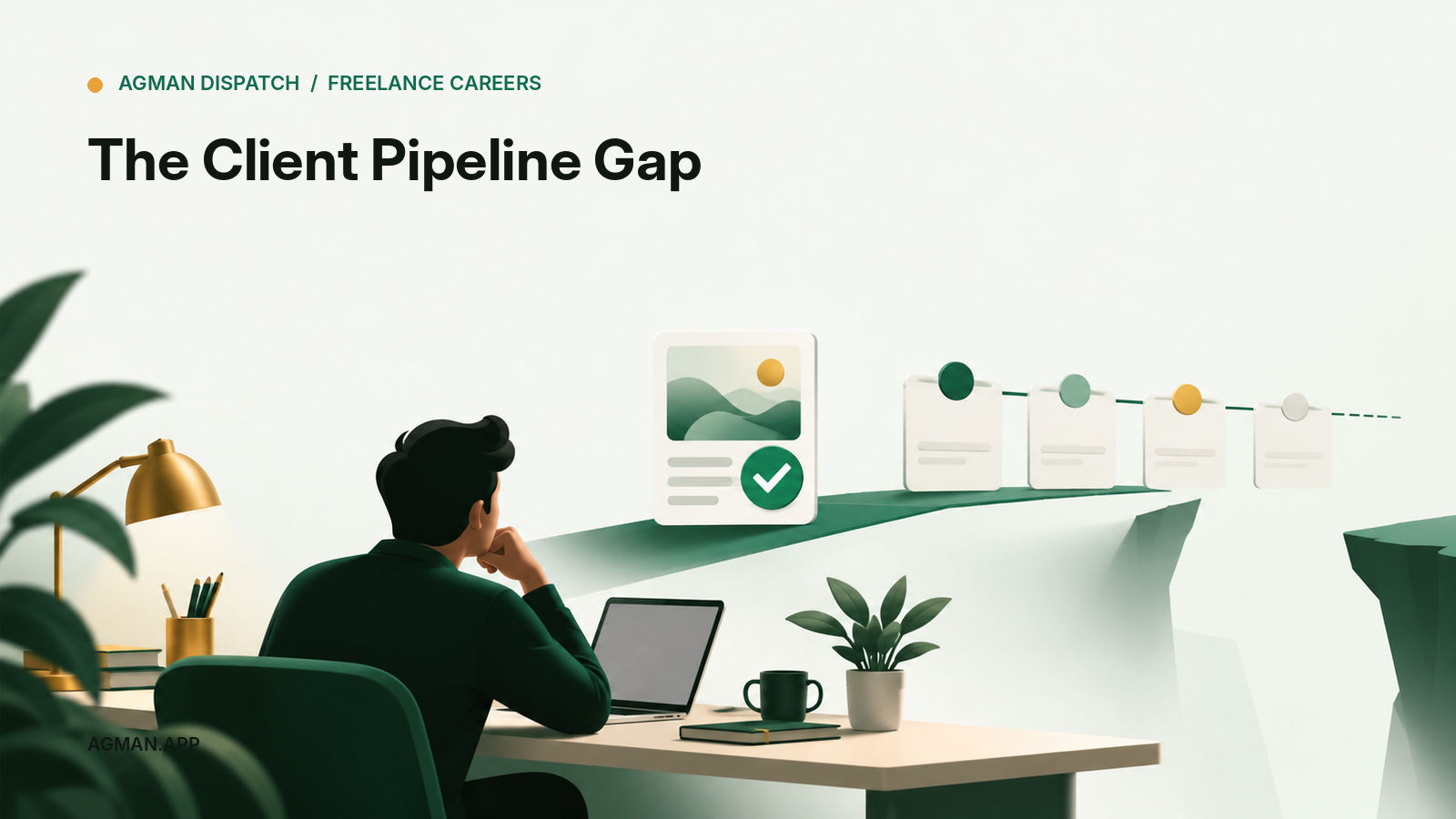
You finish a difficult project. The client is happy. The final invoice goes out. Then you open your calendar and notice something uncomfortable: nothing is coming next.
In an October 2026 discussion on r/freelancing, a designer described exactly this cycle after more than four years of freelance work. Clients came back after good projects, but new work remained unpredictable. Job boards felt crowded, cold messages attracted little response and promising conversations sometimes died before becoming a contract.
It's one person's experience, not a survey of the profession. But the distinction in that story deserves attention. Getting work, keeping work and converting interest into a paid project are different problems. Treating all three as “I need more marketing” makes it difficult to know what to improve.
A good portfolio does not automatically create a pipeline
A portfolio answers a particular question: Can this person produce good work?
A buyer usually has several others. Have they done work like mine? Will they understand my constraints? How much risk am I taking? What happens after I send the first message?
A beautiful collection of screens can demonstrate visual skill while answering none of those questions. A developer's GitHub profile may prove technical ability but not whether they can hand over a maintainable application to a nontechnical client.
Upwork's 2026 guide to finding freelance clients recommends choosing a niche, demonstrating relevant work, networking and combining inbound visibility with outreach. Those are useful starting points. The harder task is making them specific enough to influence a buyer's decision. Upwork is itself a marketplace, so its guide should be read as practitioner guidance rather than neutral evidence that any one channel reliably wins.
Consider two ways to describe the same service.
One says: “I design websites, SaaS dashboards and digital experiences.”
The other says: “I help small B2B software teams make their onboarding clear enough for customers to complete setup without a sales call.”
The second is not automatically a better business. But it gives a buyer a clearer reason to look at the work. Specificity makes a claim easier to evaluate.
Diagnose the stage where things stop
Instead of judging a month as simply “good” or “bad,” distinguish four stages.
Discovery: How many suitable buyers encountered your work or heard about you?
Interest: How many had a problem you could plausibly solve and wanted a conversation?
Decision: How many understood the proposed scope, expected outcome, timing and price well enough to make a choice?
Continuation: How many projects produced a repeat engagement, useful referral or permission to show the result?
A quiet first stage suggests you need more relevant exposure. Many interested conversations but no proposals might mean you're talking to curious people rather than buyers, or you're not establishing urgency. Proposals that repeatedly stall point toward fit, clarity, trust, price or decision timing. Strong repeat work but no new leads suggests your work is valued once discovered, while your introduction process is weak.
These are diagnostic possibilities, not conclusions you can make from counts alone. The useful evidence comes from asking what happened at each transition.
Keep a small private log: where an introduction came from, the problem described, whether you spoke, whether you proposed, the next agreed action and the eventual outcome. You do not need a complex CRM. A spreadsheet is enough if you update it honestly.
Give people evidence for the decision they're making
Imagine a hypothetical freelance designer approaching a startup that is struggling to activate new users.
A generic pitch says the designer creates modern, conversion-focused interfaces. A more useful introduction might show one relevant onboarding flow, explain which confusing step was simplified, and be transparent about what was and wasn't measured.
If the designer cannot demonstrate a conversion improvement, they should not claim one. “I simplified a nine-step flow to five steps” is a description of work. “I doubled activation” is a performance claim that requires real measurements and attribution. Good buyers notice the difference.
The same principle works for writers, video editors, accountants and developers. Show work that resembles the buyer's task. Describe the constraints and your contribution. Explain when your approach would not fit.
You do not need dozens of case studies. Two or three honest, relevant examples often make a better starting point than an impressive but unfocused wall of projects. That is a practical editorial judgement, not a measured conversion guarantee.
Stop making every new project a fresh start
Freelancers often perform marketing in the gaps between paid assignments. Unfortunately, the gap is exactly when the pressure to accept poor-fit work becomes strongest.
A more sustainable experiment is to reserve a small recurring slot while projects are active. The size matters less than the consistency and the quality of the activity.
During that slot, you might update one case study using actual completed work, contact a previous satisfied client for an appropriately timed introduction, check whether a relevant company has publicly described a problem you understand, or follow up on a proposal whose next step was already agreed.
Avoid scraping lists of strangers or sending identical messages to everyone with a job title. That may create activity without creating qualified conversations, and unsolicited outreach can violate rules and expectations. Start with existing relationships, permission and visible relevance.
Here is an example of a useful, low-pressure follow-up after an actual conversation:
You mentioned the signup flow was causing support questions. I put the two options we discussed into a one-page scope, including what I would need from your team. If this is still a priority, would reviewing it together next week help? If the timing has changed, that's useful to know too.
It works as a clear next-step request, not a magic script. If the other person is uninterested or asks you to stop, stop.
A four-week experiment instead of another marketing overhaul
For the first week, review the last several enquiries. Separate referrals, marketplace leads, direct contacts and content enquiries. Identify where interested buyers disappeared and what you actually know about why.
In week two, rewrite one service description around a narrow buyer problem. Attach one relevant piece of evidence. Ask a trusted person who resembles your target buyer what is still unclear.
In week three, test a few thoughtful introductions through appropriate, permitted channels. Don't count sent messages as opportunities. Record meaningful replies and whether the person has a real problem, budget and decision path.
In week four, review the stages. If almost nobody responds, examine your audience and offer before increasing volume. If conversations occur but proposals stall, inspect your scoping process. If satisfied clients return but introductions don't, consider how and when you ask for referrals.
This experiment won't promise four new clients in four weeks. It should give you a more useful result: evidence about where your process is failing, instead of another month of guessing.
What if the market really is difficult?
Not every empty pipeline is caused by poor positioning. Budgets can shrink, projects can be delayed, and marketplaces can become more competitive. In an August 2026 r/freelancing discussion, an experienced developer reported seeing smaller or less frequent wins among established marketplace freelancers. That is a personal observation, not proof of a market-wide decline.
The point is not to place every burden on the freelancer. A disciplined process does not create demand where none exists. Sometimes the best decision is to broaden the type of buyer, adjust the service, take a longer contract or pursue employment while keeping freelance work selective.
But it helps to know whether you have a market problem, a visibility problem or a conversion problem before spending more money on marketing.
The next time a project ends, the question should not be only “Where can I post my portfolio?” A better question is: Which kinds of buyers already trust my work, how did they find me, and what would make that introduction repeatable?
A reliable pipeline begins when you can answer that with evidence rather than hope.