You can spend weeks preparing for something that lasts a day.
The screenshots are ready. You've rewritten the tagline more times than you care to admit. You've tested the signup flow, prepared the announcement and chosen a date.
Then the product goes live.
People visit. Some leave comments. A few may sign up. By the following week, the announcement is no longer new.
Was it a successful launch?
That depends on what you were hoping to achieve.
A founder looking for early testers needs something quite different from a team launching an established product. One might value ten thoughtful conversations more than a thousand curious visitors. Another might want enough qualified signups to justify investing in a new feature.
Yet both can easily get caught up in the same launch-day numbers.
This is why choosing where to launch deserves more thought than choosing when.
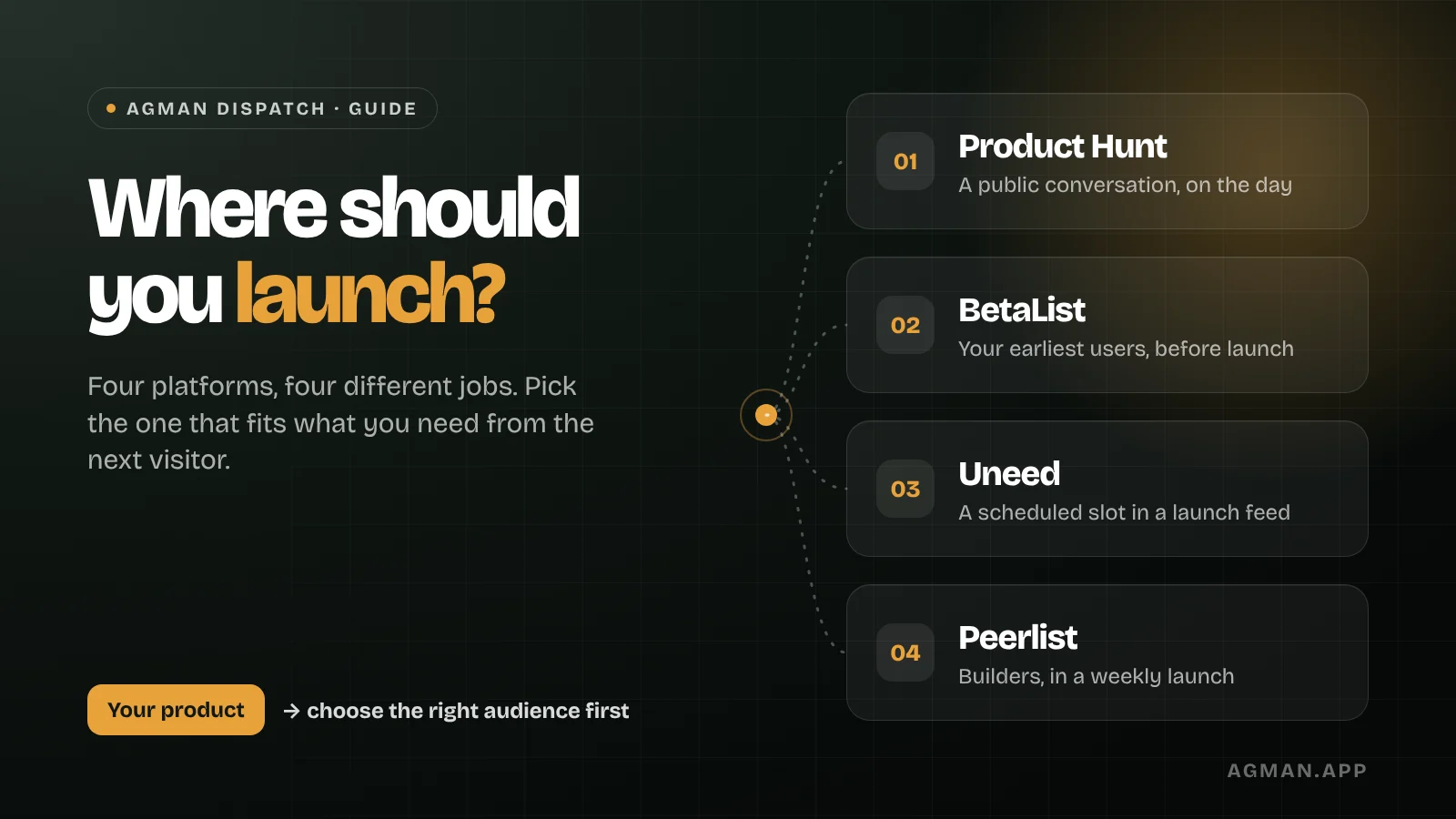
Four platforms worth understanding are Product Hunt, BetaList, Uneed and Peerlist. They overlap, but each approaches product discovery differently.
Product Hunt: when your product is ready for a public conversation
Product Hunt's launch guide encourages makers to prepare well before their chosen day.
You need more than an interesting name. People should be able to understand what the product does, see it working and decide whether it is relevant to them.
Product Hunt brings together makers, technology enthusiasts and people interested in trying new products. A launch creates an opportunity for discussion, feedback and visibility.
But appearing on the homepage isn't guaranteed. Product Hunt applies its own featuring criteria, with an emphasis on useful, accessible digital products.
That distinction matters.
A launch is an opportunity to introduce something. It isn't a promise that everyone will see it.
If you're preparing for Product Hunt, spend less time worrying about your potential rank and more time answering three questions:
- Can a stranger understand what you've built in a few seconds?
- Can they actually try it?
- Are you ready to respond when someone questions how it works?
The conversations can be more useful than the ranking.
Someone pointing out a confusing feature or explaining why they wouldn't use your product has given you information you can act on. An upvote alone tells you considerably less.
Product Hunt also discourages requests and incentives for upvotes. Invite people to explore the product and join the discussion instead.
Choose Product Hunt when your product is usable, your explanation is clear, and you're ready for public feedback.
BetaList: when you're still looking for your earliest users
Imagine you've built the first working version of a product, but you haven't yet decided whether it solves the problem well enough.
You need people willing to try something unfinished, point out what doesn't work and perhaps return when you've improved it.
That's a more natural situation for BetaList.
BetaList's submission guidelines focus on relatively new technology startups, including unreleased products, private betas and recently launched services.
It expects a proper product landing page, ideally on your own domain, where visitors can sign up or get access.
It also allows eligible startups two separate opportunities to be featured: one before launch and another when the product launches, with time between them.
This creates a useful distinction between gathering early interest and making a public announcement.
Suppose you're building an accounting tool for small businesses.
At the beginning, you may be more interested in whether five business owners understand the workflow than whether hundreds of people appreciate the design.
A small group of relevant testers can help you answer questions that casual traffic cannot.
But BetaList isn't suitable for every kind of business. Its guidelines exclude categories such as blogs, newsletters, agencies and consultancies.
Consider BetaList when you have a genuine early-stage technology product and need people who are willing to explore it before or around launch.
Uneed: when you want a defined launch opportunity
One of the difficulties with launching is timing.
You may have the product ready, but you're still preparing the announcement, arranging demonstrations or coordinating the people involved.
Uneed offers a more structured way to enter a product-launch feed.
Its current launch process includes a free waiting line with an automatically assigned date, alongside paid options for faster or date-specific launches.
The free waiting period can extend from 30 days to five months. Its free and fast-track options also have voting requirements that affect whether a page remains published and whether its backlink is followed. These details are worth checking before choosing a launch option.
Uneed also maintains daily, weekly, monthly and yearly leaderboards.
A product can therefore continue appearing in ranking contexts beyond the day it launches, although that doesn't mean continued traffic or high placement is assured.
This setup can be useful when you want a specific opportunity to introduce a product and observe how it performs among other launches.
But the timing should support your marketing plan, rather than become the plan itself.
A scheduled launch is only valuable if the product page is ready, the offer is understandable and visitors have something useful to do when they arrive.
Consider Uneed when its scheduling options, product audience and ranking format suit what you're trying to achieve.
Peerlist: when the people building software are your audience
Not every product needs the broadest possible audience.
Consider a tool that helps developers examine slow database queries.
It may have little relevance to most internet users. But put it in front of developers facing that exact problem and the conversation becomes much more useful.
That's where Peerlist Launchpad has an interesting role.
Peerlist Launchpad runs weekly launches, with an audience centered on developers, designers and other people building digital products.
Projects can gather feedback and community support during the launch week. The top three are eligible for recognition on their profiles and newsletter exposure.
The weekly format gives makers a different rhythm from Product Hunt's daily launch competition.
For developer tools, design resources and products built for technical teams, Peerlist may offer particularly relevant conversations.
That doesn't guarantee those conversations will turn into users. A developer might appreciate an idea without needing the product.
But a thoughtful response from someone who understands the problem can be more valuable than broad attention from people who don't.
Consider Peerlist when you're building for developers, designers or a closely related professional audience.
The better question is what you want from the next visitor
All four platforms can introduce people to new products. None can make an unsuitable product relevant to the wrong audience.
Before deciding where to launch, imagine the next person who discovers your product.
What would you like them to do?
If you're testing whether the idea solves a real problem, you probably want someone to try the product and tell you where they struggle.
If your product is already public, you might want a visitor to understand its value and become a user.
If you're building for developers, an informed technical conversation may be particularly useful.
And if you're launching a service for local businesses, none of these technology-focused launch communities may be your strongest channel.
That last possibility is easy to overlook.
Sometimes the best place to introduce something isn't a launch platform at all. It may be an industry community, an existing customer network, a local professional group or an article answering a specific problem.
The right audience matters more than being present on every launch board.
What happens when the launch is over?
There's a small but important difference between someone discovering a product because it's new and discovering it because they need it.
Launch platforms are particularly useful for the first situation.
The second can happen at any time.
Someone might begin looking for an invoice-processing tool three months after you launched. They weren't following the launch rankings. They simply have invoices to process and want a solution.
They need to understand what your product accepts, what it produces, how it works and whether it suits their situation.
Your launch-day announcement may still exist, but it shouldn't be the only place that explains those things.
A useful post-launch routine doesn't need to be complicated.
First, revisit your product description.
Look at the questions people asked during your launch. If visitors misunderstood what the product does, there's a reasonable chance future visitors will have the same problem.
Improve the explanation on your own website and wherever your product appears.
Then give real changes a reason to be noticed.
A new integration, an improved workflow, a useful demonstration or a meaningful change in availability can make a product worth revisiting.
Repeatedly announcing that your product exists gives people little new information.
Finally, pay attention to what visitors actually do.
A platform might send plenty of visits but few meaningful enquiries or signups. Another might send less traffic but more people who are genuinely interested.
Use the tracking you have available to investigate the difference. Don't assume every visit becomes a customer, or that the source with the most clicks delivered the most value.
And keep talking to the people who showed interest. Their questions are often a better starting point for your next improvement than another promotional campaign.
A place for discovery between launches
This is also where ongoing discovery networks can contribute.
AGMAN, for example, lets publishers maintain a public profile describing what they offer, who it is for and the relevant links or evidence someone can inspect.
Visitors can discover profiles through search, categories, editorial Collections and Find by Need, which helps them look for something based on the task they want to accomplish.
Publishers can also share current Updates, including offers, announcements, events and availability, instead of relying entirely on their original launch message.
These features provide additional ways for a product to be evaluated and discovered. They don't guarantee an audience, search-engine rankings, traffic or sales.
If you already have a launch date on one of the platforms above, AGMAN also sells a Launch Pack. This is our own paid product: for $49, added to the $10 Grow Pass, your launch appears in a shared Dispatch issue, marked as a paid placement, and is shared on AGMAN's social accounts on the day. It sends people to your launch page. It doesn't replace the launch platform, and it doesn't promise visits. See how it works
You can explore how AGMAN works for publishers if an ongoing discovery profile fits your plans.
The larger principle applies beyond any one platform: wherever someone encounters your product, they should have enough information to decide whether it is worth their time.
Give your launch a purpose before giving it a date
There's no need to launch everywhere at once.
If you have an unfinished technology product, begin by finding appropriate testers. If you're ready for a wider announcement, choose a community where people are likely to care. If your product serves a specialist audience, look for the places those specialists already spend time.
Then make sure your product remains understandable and accessible after the announcement has passed.
A launch can start a conversation. A useful product, clear explanation and continued engagement give that conversation somewhere to go.
The date is only one part of the work.