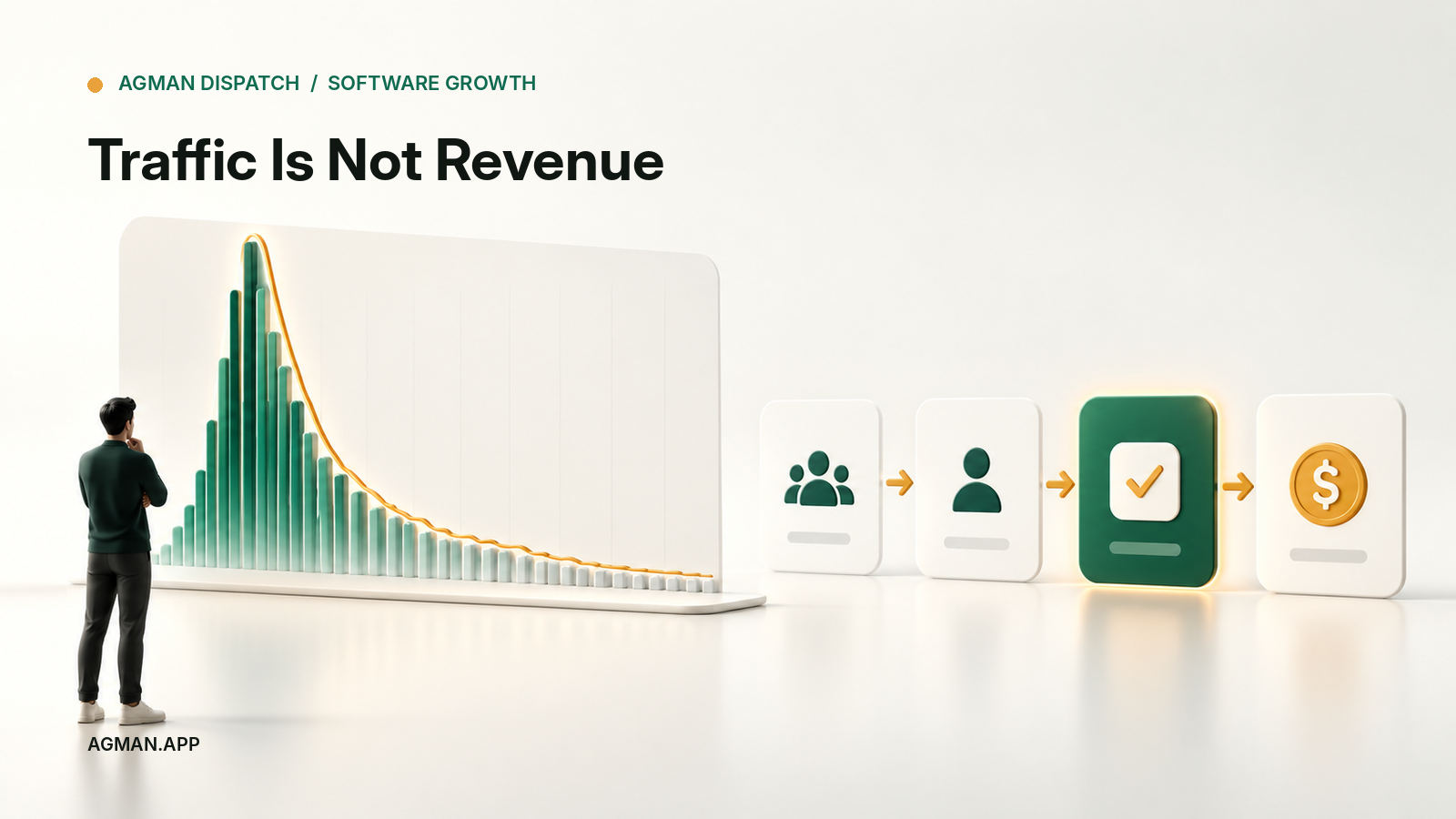
A launch can make the dashboard look healthy for a day. Visitors arrive, the traffic chart rises, and a handful of people start a trial. Then the graph drops back down. At the end of the week, there are still no paying customers.
It's tempting to explain this as a distribution problem. Maybe the launch platform did not promote the product enough. Maybe the founder needs a larger audience, a more impressive landing page or another launch somewhere else.
Those things might matter. But until you know what the visitors actually did, more traffic could simply send more people through the same broken experience.
A launch is a source of attention, not proof of demand
Visitors can arrive for reasons that have little to do with buying. Some are curious founders, competitors or people who enjoy browsing new software. Others are genuinely searching for a solution. A total visit count combines them.
The first useful question is not how many people arrived. It is how many of the arriving people plausibly matched the buyer you had in mind.
Imagine a hypothetical product that helps small agencies prepare client reports. The founder launches it in a general startup community. Five hundred people visit. Fifty explore the demo. Ten create an account. Three connect a data source. No one pays in the first week.
These are illustrative numbers, not AGMAN analytics or a case study. They show why a single conversion percentage can conceal several different questions. Did the landing page attract the wrong audience? Did the demo communicate value? Was connecting a data source too hard? Was one week too soon to evaluate a business purchase?
You cannot decide from the visitor count.
Use the correct denominator at each stage
Draw a simple sequence for the product you actually built:
Qualified visit → signup or trial → core action completed → value experienced → repeat use → payment.
Not every product has the same stages. A paid-upfront SaaS may skip a free trial. A service marketplace might measure enquiries and completed introductions instead. What matters is making the intended journey explicit.
Now calculate the drop between adjacent steps with the same time window and a clearly defined group of users. Do not divide payments from this month by signups from an unrelated period and call it a conversion rate. And do not call an email-address submission activation merely because an analytics dashboard labels it a conversion.
A report published in March 2026 by ChartMogul and ProductLed examined conversion data from 200 B2B software products. It reported a median free-to-paid conversion rate of 8% across the sample. That is an observed sample statistic, not a guaranteed target for a new product, and its conversion windows and product models are not interchangeable with a launch-week tally.
Amplitude's startup product benchmarks separately distinguish acquisition, activation, engagement and retention. Its underlying dataset covers digital products using its measurement systems. That makes the framework useful, but it is not a population-wide rule for every type of business.
A founder who says “my conversion rate is zero” therefore needs to answer: conversion from what, to what, among which users, and over how long?
Find the moment of actual value
A visitor who lands on the pricing page has learned a price. A signup has completed a form. Neither necessarily means the product solved anything.
The stronger diagnostic is the first meaningful action that creates the promised outcome.
For the hypothetical agency reporting tool, this might be generating one usable report from real client data. Connecting an account is a prerequisite, not the final value. If ten people register and none completes that report, offering a discount is unlikely to fix the first problem.
Write down the value event in language a customer could recognize. For a transcription tool, it could be receiving a usable transcript from an actual recording. For a schedule assistant, it could be turning a real task list into a plan the user follows. Avoid definitions like “clicked button” unless that button itself represents the delivered job.
Then test the path with a person who matches your intended buyer. Ask them to attempt a normal task. Observe where they stop, without coaching them toward the answer. Get permission before recording or collecting personal information.
A short, supervised observation often gives you a sharper question than broad opinions such as “Would you use this?”
Four reasons an interested visitor may not pay
The audience was curious but not qualified. A product-launch crowd may like software without having the actual problem. The response is to test a better-fitting audience, not immediately redesign checkout.
The promise was unclear. People may understand the features without understanding the result. Use one plain, verifiable example of the work a customer can finish. A feature list is not a substitute for the job being done.
The first useful action required too much work. Permissions, imports, complex settings, unclear errors or long setup can stop a trial. Reduce unnecessary steps without misrepresenting the complexity the product genuinely requires.
The value was real, but the commercial decision was different. A business buyer may need approval, a security review, a budget cycle or a longer trial. A zero-payment first week is not automatically proof that nobody will ever buy. Conversely, praise without continued usage is not validation.
These are competing explanations. Check which one fits the evidence instead of declaring one universal reason for every startup.
A two-week diagnosis for the next launch
During the first two days, define the qualified visitor and the single value event. Check that basic event tracking works and respects users' privacy choices. Test the journey yourself from a fresh account.
Over the next several days, review a small set of voluntarily recruited, suitable users. Ask what they expected, which step surprised them and what would have made the task easier. Include people who left, if they have given permission to be contacted. Avoid treating a few positive replies as representative evidence.
Next, compare the ways people arrived. Did a targeted conversation produce fewer visits but more completed tasks than a general launch? If so, that may be more informative than the total number of impressions.
Finally, change one meaningful part of the journey. Test a clearer first-use example, a shorter setup sequence or a tighter audience, depending on where the evidence points. Keep the outcome definition and observation window stable so you can interpret the change. With a tiny sample, the result is a directional observation, not a statistically certain improvement.
When another launch actually makes sense
A relaunch can be useful when the product has changed materially, when a new audience has a credible reason to care, or when prior demand was real but reached through an unsuitable channel.
It is less useful when you still do not know why the earlier visitors left.
Some products genuinely need more awareness. Others need a different market, clearer proof or a better first-use experience. A few may need to be stopped. The role of research is to distinguish these cases before spending more effort.
Your traffic chart tells you somebody arrived. A meaningful value event tells you whether your product helped. Repeat use and payment help show whether the result mattered enough to return or buy. None of those measurements alone tells the whole story.
Before planning the next launch, follow one suitable visitor all the way through the product. Find the step where the promised outcome disappears. That is where the next useful experiment begins.
Sources and limitations
- ChartMogul / ProductLed, SaaS Conversion Report, March 2026: sample of 200 B2B software products; figures are not universal launch-week conversion targets.
- Amplitude startup product benchmarks: operational definitions and comparative metrics from its own dataset; selection limitations apply.
- The agency reporting tool and all illustrative counts are hypothetical, not verified customer results.