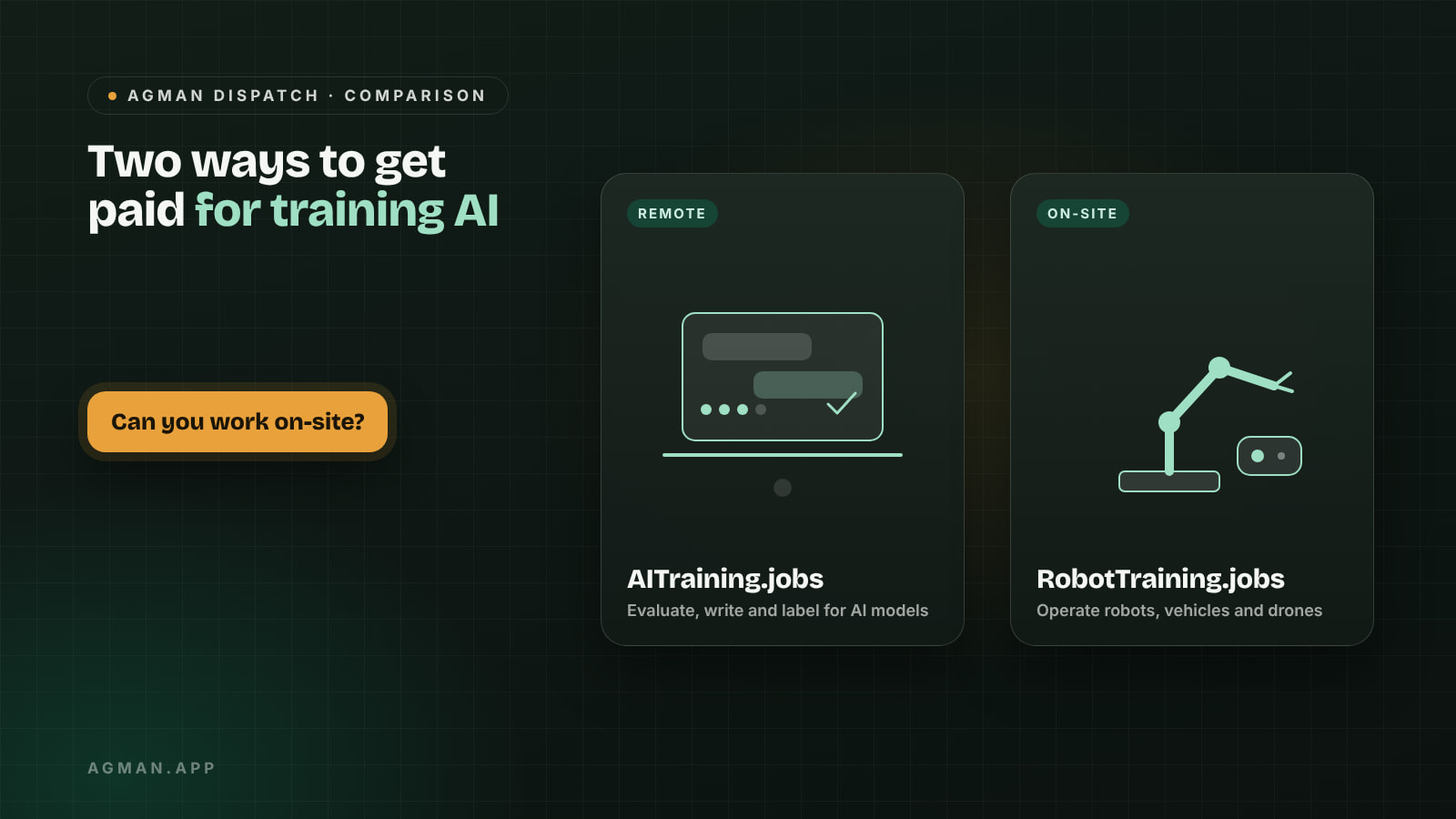
"Get paid to train AI" now describes two very different jobs. One is writing, checking and ranking answers from AI models at a desk, often from home, using what you already know about coding, medicine, law or a language. The other is physically operating robots, vehicles or drones so their movements can be recorded and learned from, usually at a company's site.
Two job boards listed on AGMAN cover these two sides: AITraining.jobs and RobotTraining.jobs. They look alike, with hourly pay shown on every listing, but they lead to different kinds of work, in different places, for different people. Picking the right one comes down to two questions: can you work on-site, and what do you already know?
Figures below come from each site's own pages, checked on 21 October 2026. They're the sites' own counts and estimates, not numbers AGMAN has verified, and job boards change daily.
Which one should you use?
- AITraining.jobs if you want remote work that uses a skill or subject knowledge: evaluating AI answers, coding tasks, maths, writing, medical or legal review, or work in another language.
- RobotTraining.jobs if you can work on-site and want hands-on operator work: teleoperating robots, recording demonstrations, labelling sensor data, or driving and flying test vehicles.
| AITraining.jobs | RobotTraining.jobs | |
|---|---|---|
| Kind of work | Evaluating, writing and labelling for AI models | Operating robots, vehicles and drones for training data |
| Where | Largely remote work | Mostly on-site; 3% of listings remote, per the site |
| What it draws on | Platforms such as Mercor, Outlier, DataAnnotation and Prolific | Robotics and autonomous-vehicle employers' own job boards |
| Pay shown | Hourly pay each role advertises | Hourly pay each role posts |
| Typical skills | Subject knowledge, writing, coding, languages | Reliability on shift; some roles need a licence or drone certificate |
| Cost to use | Free, no sign-up (per its listing) | Not stated in its listing |
What does AITraining.jobs cover?
AITraining.jobs collects openings from the platforms that pay people to train and evaluate AI models. Its platform guide ranks those platforms, and its listing on AGMAN says it pulls openings daily from 25 platforms' own job feeds, covering RLHF and evaluation, coding, maths, writing, expert work in law, medicine and finance, voice and multilingual roles.
Its strength is comparison. The pay explorer puts advertised hourly rates side by side, and its 2026 pay report gives a live median of $60 an hour across the roles it tracks. That figure covers a wide spread. The site's own platform pages range from crowd microtask sites paying a few dollars an hour to specialist medical and finance work advertised in the hundreds.
One disclosure worth knowing: AITraining.jobs' own site says its founder is also a co-founder of HeroHunt.ai, an AI recruiting platform. That doesn't make the listings wrong, but it's a commercial connection to the hiring industry, and it's fair to read the platform rankings with that in mind.
What does RobotTraining.jobs cover?
RobotTraining.jobs collects robot training, teleoperation and data-collection roles and, according to its homepage, checks every listing against the employer's job board each day. When we checked, it showed 1,029 open roles, with the largest groups in autonomous vehicle and drone work, fleet operations and "egocentric capture" (recording tasks from a first-person view).
This is mostly in-person work. The site says 61% of its listings are limited to the US and 3% can be done remotely. Its median posted rate was $25 an hour, based on the rates employers actually published. Its FAQ notes that teleoperation and labelling roles generally don't need a degree, while driving roles need a clean licence and US drone roles need an FAA Part 107 certificate.
Why are the pay figures so different?
Because the work is different, and so is the way it's counted. AITraining.jobs' $60 median includes expert roles that pay for professional knowledge. RobotTraining.jobs' $25 median comes from operator roles that pay for time on shift. Neither median tells you what you'd earn.
Two cautions apply to both. Advertised rates are often a range or an "up to" figure, and remote AI-training work in particular can be irregular, with weeks of plenty followed by none. Read each platform's terms on how tasks are assigned and paid before you count on an income.
How do you tell a real opening from a scam?
Wherever you find an opening, apply through the original employer or platform. A few checks help:
- Never pay to apply or to buy "training" for a job. Legitimate platforms pay you, not the other way round.
- Apply on the platform's own site, and check the web address matches the company.
- Look for reviews from workers about how reliably tasks and payments arrive, not only how much the hourly rate says.
- Be careful with identity documents. Real platforms may verify identity, but only through their official sign-up process.
Is a job board better than applying directly?
Not always. If you already know which platform suits you, applying there directly is quicker and you'll see openings first. The value of a board like these is breadth: you can see who is hiring for your skill this week and what they say they pay, without checking dozens of sites. Using a board to find options and then applying directly is a sensible mix.
A checklist before you apply
- Decide whether you can work on-site, and in which country.
- Write down the skill you're offering: a subject, a language, coding, or reliable shift work.
- Use the matching board to shortlist three to five openings.
- Check each employer's own site, terms and worker reviews.
- Track how much work actually arrives in your first month before relying on it.
Where AGMAN fits
AGMAN lists both boards, and you can describe what you're looking for in your own words with Find by Need, such as "remote work evaluating AI answers" or "robot operator jobs", and see why each result matches. Neither site paid for this article, and their details above are what they publish about themselves. If you run a job board or platform in this space, you can publish a page from your website link and review it before it goes live.